
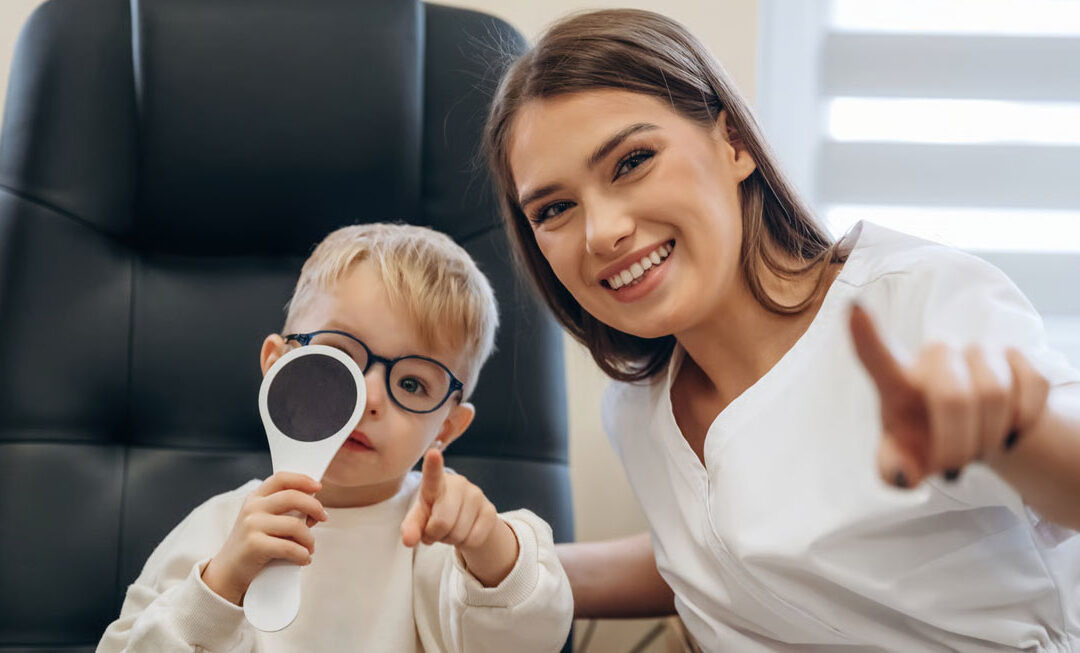
When parents think about keeping their children healthy, vision often falls somewhere lower on the list than it should. Pediatric visits, dental cleanings, vaccines these feel urgent and non-negotiable. Eye exams, by contrast, tend to get scheduled reactively, if at all. A teacher mentions that a child seems to be squinting at the board. A pediatrician flags something at a routine checkup. Or a parent simply notices their child holding a book uncomfortably close and finally makes the call.
The challenge is that children almost never complain about their vision not because nothing is wrong, but because they have no frame of reference for what clear vision is supposed to feel like. If a child has always seen the world in a certain way, that’s simply the world to them. They don’t know they’re missing anything. And that’s precisely what makes regular comprehensive eye exams so critical during the years when the visual system is still developing and interventions are most effective.
The Visual System Is Still Developing — And the Window Is Finite
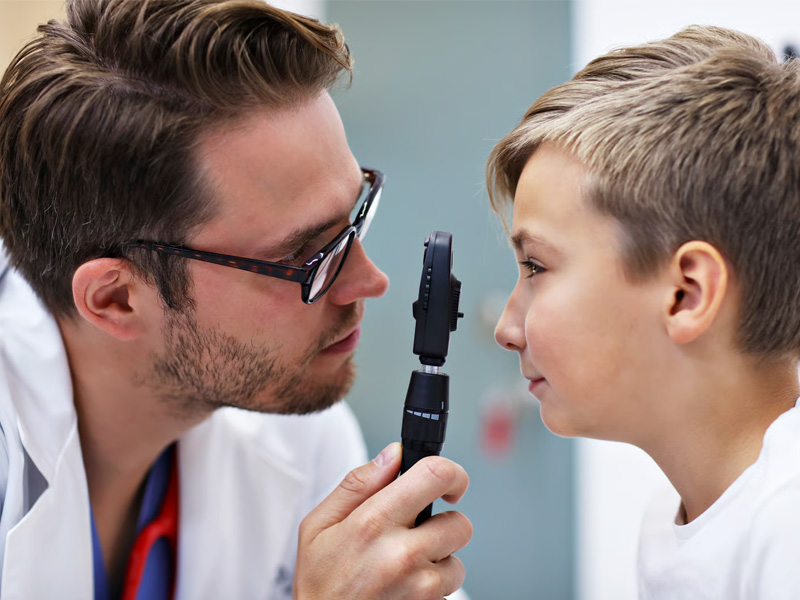
Vision is not fully developed at birth. The eyes and brain work together to build the visual system progressively over the first several years of life, with the most critical period of development occurring between birth and approximately age seven or eight. During this window, the brain is actively learning to process and interpret visual information from both eyes simultaneously. If something interferes with that process — an uncorrected refractive error, a misalignment of the eyes, or unequal vision between the two eyes — the brain can begin to suppress input from the weaker eye, leading to a condition called amblyopia, more commonly known as lazy eye.
Amblyopia affects roughly two to three percent of children and is the most common cause of vision impairment in children and young adults. It is also highly treatable — but only when it’s caught early enough. The visual system remains plastic and responsive to treatment during childhood. Once the developmental window closes, typically around age nine or ten, amblyopia becomes significantly harder to correct and the vision loss may be permanent. A comprehensive eye exam during the early years is the only reliable way to detect it.
The Connection Between Vision and Learning
Here is something that surprises many parents: approximately eighty percent of learning in a classroom is visual. Reading, writing, copying from a board, interpreting charts and diagrams, tracking lines of text all of it depends on a visual system that is working accurately and comfortably. When it isn’t, the impact on a child’s academic experience can be profound.
A child with uncorrected farsightedness may be able to see the board clearly but struggle intensely with close-up reading because the effort of focusing at near distances causes rapid eye fatigue, headaches, and avoidance. A child with convergence insufficiency a condition where the eyes have difficulty working together at close range may skip lines while reading, lose their place constantly, or experience words that appear to move on the page. Neither of these children is likely to tell their parent that their eyes hurt or that reading feels unusually hard. They’re more likely to be labeled as distracted, unmotivated, or struggling academically.
Studies have consistently found that a meaningful percentage of children diagnosed with reading difficulties or attention problems have an underlying, uncorrected vision condition contributing to or driving the behavior. In many cases, addressing the vision issue produces rapid and dramatic improvement in academic performance without any other intervention.
Signs That Your Child May Have a Vision Problem
Because children rarely self-report vision difficulties, parents and teachers are often the first to notice the signs. Some are obvious. Many are not. Here are the indicators worth paying close attention to:
- Sitting very close to the television or holding books and devices closer than seems comfortable
- Frequent eye rubbing — especially during or after reading or close work
- Tilting the head or covering one eye when looking at something, which can indicate a problem with binocular vision
- Squinting at distant objects, the board at school, or during outdoor activities
- Complaints of headaches that seem to occur primarily during or after school or homework time
- Losing their place while reading, skipping lines, or using a finger to track text unusually heavily
- Short attention span for visual tasks — books, puzzles, or screens — when they seem engaged and attentive otherwise
- A visible turn or drift in one or both eyes, particularly when the child is tired
- Sensitivity to light that seems excessive relative to the situation
- Avoiding activities that require sustained near vision — reading, drawing, or detailed handwork — without a clear behavioral explanation
None of these signs definitively confirms a vision problem, but any one of them is a reason to schedule a comprehensive eye exam rather than waiting for the next routine checkup.
What a Children’s Eye Exam Actually Involves
One of the most common reasons parents delay scheduling their child’s eye exam is uncertainty about what the experience will be like — particularly for very young children who can’t yet read or reliably communicate what they’re seeing. The good news is that comprehensive pediatric eye exams don’t require a child to read a chart or answer complex questions. Optometrists who work with children are trained to assess visual acuity, eye alignment, focusing ability, and eye health using objective techniques and age-appropriate tools that work even with infants and toddlers.
For school-age children, the exam typically includes a full assessment of distance and near vision, a check of how the eyes work together, an evaluation of focusing flexibility, and an internal and external health examination of both eyes. The entire process is gentle, non-invasive, and for most children, genuinely interesting. Many kids leave more enthusiastic about returning than their parents expected.
When Should the First Exam Happen?
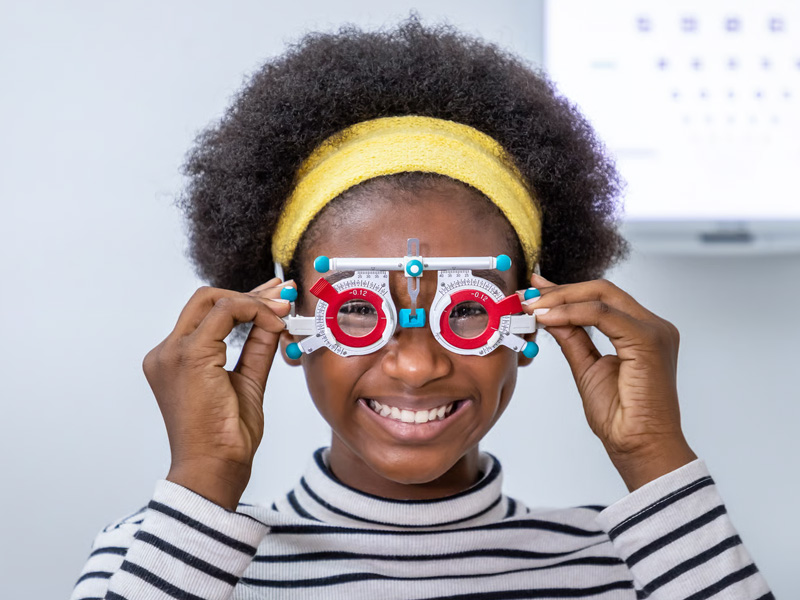
The American Optometric Association recommends a child’s first comprehensive eye exam at six months of age, a second between ages three and five, and then annually from the time they start school onward. These guidelines exist because different conditions present and are best detected at different developmental stages — and because early detection consistently produces better outcomes than late detection.
If your child has a family history of amblyopia, strabismus, or significant refractive error, earlier and more frequent exams are warranted. The same applies if your child was born prematurely, has a developmental delay, or has been flagged for academic difficulties that don’t have a clear explanation.
A school vision screening is not a substitute for a comprehensive eye exam. Screenings test a limited range of visual functions and miss a significant percentage of conditions — including many of the binocular vision problems most likely to affect learning. Passing a school screening is reassuring, but it does not mean a child’s visual system has been fully evaluated.
An Investment in How They See the World — Literally
A child who sees clearly and comfortably has a fundamentally different experience of school, reading, sports, and daily life than one who is quietly struggling with an undetected vision problem. The difference isn’t always dramatic or obvious from the outside — but inside, in terms of effort, fatigue, frustration, and confidence, it can be enormous. Catching and correcting a vision problem early doesn’t just improve how well a child sees. It changes how they experience learning, and that effect compounds over every year of their education.
Give your child the clearest possible start. Schedule their comprehensive eye exam today — because what they can see shapes everything they can become.